
AD5 2026 language choices: what our survey tells us about candidate strategy
The AD5 2026 competition has already broken one record: EPSO confirmed that more than 170,000 people applied before the deadline of 10 March 2026.
That is far beyond expectations and immediately changes the strategic context in which candidates are preparing.
Against that backdrop, we wanted to understand one specific question:
👉 How are candidates actually making their language choices?
Over a few days, we received almost 500 responses from candidates preparing for — or considering — the AD5 Generalists competition. The overall pattern was very clear. But to keep the analysis rigorous, the detailed quantitative breakdown below is based on the 482 responses that were fully validated, including 481 complete L1–L2 pairs. The additional late responses did not change the overall picture.
This article is not about declaring a “correct” language strategy for everyone. It is about understanding what candidates are doing, what that may signal, and how to think about the trade-offs more clearly.
1. First, a note on what this survey is — and what it is not
This is not a representative sample of the full AD5 population. With 170,000+ applicants, no one should pretend that a few hundred responses can describe the entire competition.
It is, however, a very useful snapshot of a more specific group: candidates who are already engaged with the preparation ecosystem. That matters, because preparation behaviour is not evenly distributed across the whole candidate pool. Some people apply and only engage lightly; others actively look for materials, communities, guidance and structured preparation.
That distinction matters even more in our case because the survey was shared through YSE-related channels. In the “open” survey, 72.4% of respondents already knew YSE and another 20.3% explicitly identified themselves as “croquetillas”. In other words, 92.7% of the open sample was already inside, or very close to, the YSE ecosystem.
So yes: there is a clear Spanish-speaking skew in the sample, and no: these numbers should not be presented as if they described the whole AD5 competition. But they are highly relevant for understanding the behaviour of the kind of candidates who are already actively engaging with preparation. For YSE, that is not a side segment. It is the core audience.
💬 This dataset does not describe all candidates — it describes how engaged candidates behave.
2. Why language choice matters more than many candidates think
EPSO’s own guidance is clear on two points. First, for most competitions, candidates usually choose two different official EU languages, in line with the Notice of Competition. Second, language choices cannot be changed after the application deadline. Candidates are explicitly told to choose the languages in which they are likely to perform best.
That means language choice is not just an administrative box-ticking exercise. It directly shapes:
- the environment in which you prepare
- the resources you use
- the language in which you practise reasoning and written tasks
- and the conditions under which you will actually be assessed
In a high-volume competition, these are not marginal details.
💬 Language choice is not administrative — it shapes your preparation, your resources and your performance.
3. Language 1: the linguistic profile of the validated sample
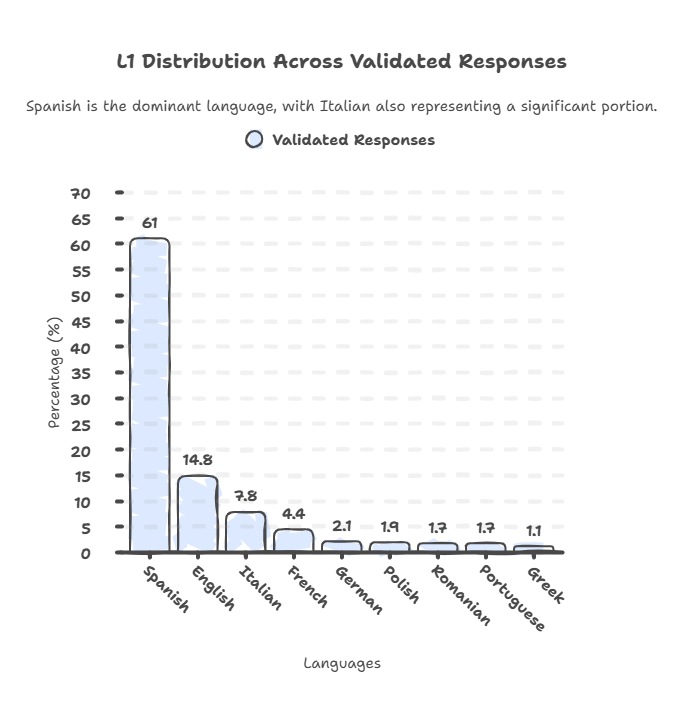
Across the validated responses, the L1 distribution was as follows:
- Spanish: 61.0%
- English: 14.8%
- Italian: 7.8%
- French: 4.4%
- German: 2.1%
- Polish: 1.9%
- Romanian: 1.7%
- Portuguese: 1.7%
- Greek: 1.1%
The Spanish-speaking dominance is obvious and should be acknowledged upfront. But two additional points are worth stressing.
First, the sample is not exclusively Spanish. There is a meaningful Italian group, a smaller but relevant French-speaking group, and several smaller clusters from Central and Eastern Europe.
Second, once we move from L1 composition to L1–L2 behaviour, the real strategic pattern becomes much more interesting.
📊 GRAPH 1 — L1 distribution
4. Language 2: one option dominates
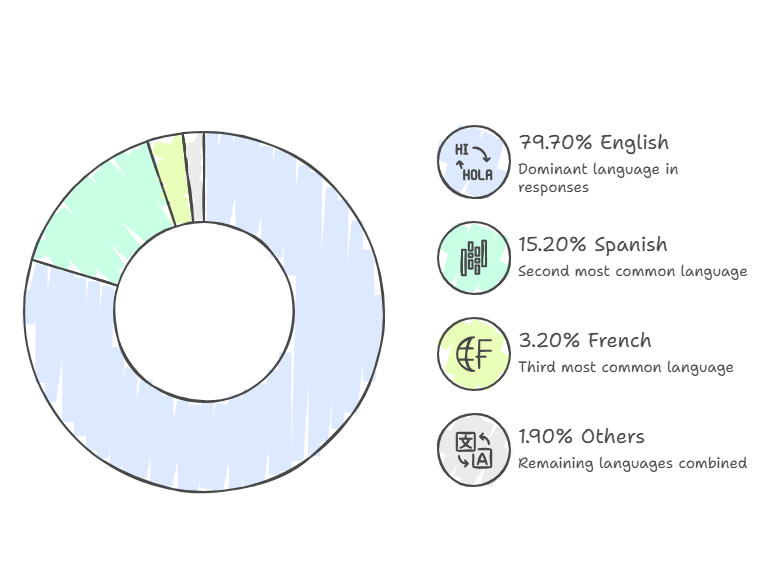
Across the validated L2 responses, the distribution was:
- English: 79.7%
- Spanish: 15.2%
- French: 3.2%
- Italian: 0.4%
- Romanian: 0.4%
- Polish: 0.4%
- German: 0.2%
- Other: 0.4%This is the first major insight of the dataset:
👉 English does not simply lead. It dominates.
And crucially: no second L2 emerges as a comparable strategic option
💬 This is not “English vs others”. This is “English vs fragmentation”.
📊 GRAPH 2 — L2 distribution
5. The real pattern: convergence towards L1 + English
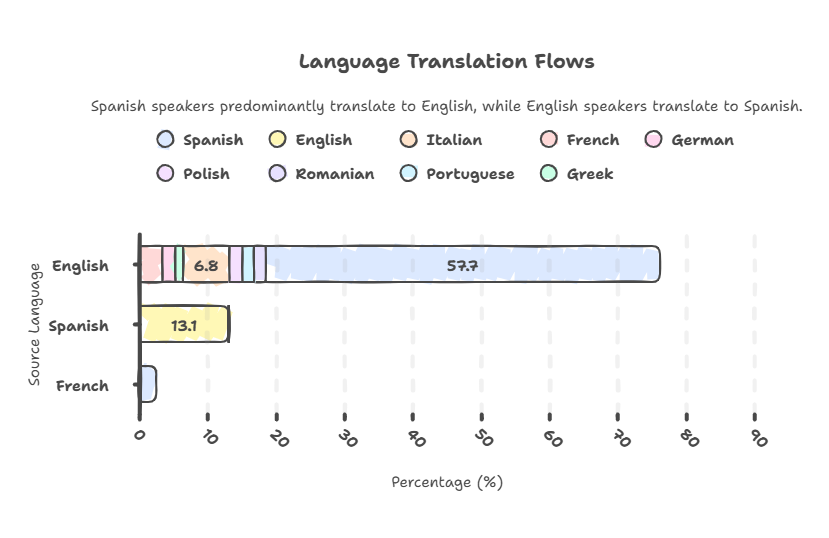
Looking at validated combinations:
- Spanish → English: 57.7%
- English → Spanish: 13.1%
- Italian → English: 6.8%
- French → English: 3.4%
- Spanish → French: 2.5%
- German → English: 1.9%
- Polish → English: 1.9%
- Romanian → English: 1.7%
- Portuguese → English: 1.7%
- Greek → English: 1.1%
- All other combinations: 8.2%
💬 Candidates from very different L1 backgrounds are converging towards the same model: L1 + English.
📊 GRAPH 3 — L1 → L2 flows
6. The strongest signal: preparation reinforces the choice
In the open survey:
👉 72.4% chose English as L2
Among YSE students:
👉 85.9% chose English
Among non-native English speakers:
👉 93.3% chose English
💬 The deeper candidates go into preparation, the stronger the convergence towards English.
7. What this does — and does not — mean
Two incorrect conclusions:
❌ “Everyone chooses English → you should too”
❌ “Language choice does not matter”
👉 The correct interpretation:
Candidates are navigating a trade-off between access to resources and working performance.
💬 Language choice is a strategic trade-off — not a default.
8. The structural insight: no second model exists
What matters as much as English dominance is the absence of an alternative:
- Spanish: 15.2%
- French: 3.2%
- others: marginal
9. Practical recommendations for candidates
The data does not point to a single “correct” language choice. But it does allow us to identify where candidates tend to underestimate the implications of that decision.
The first mistake is to treat language choice as something secondary, or as a box to tick quickly in the application form. In reality, it is one of the earliest structural decisions in the process, because it conditions not only the exam itself, but the entire preparation phase leading up to it.
A second common mistake is to follow the majority without reflection. The fact that 79.7% of respondents chose English as L2, and that this figure rises to 85.9% among candidates already preparing, is clearly informative. But it is not prescriptive. A dominant pattern in the data reflects behaviour — not necessarily optimal choices for every individual.
At the same time, the opposite mistake is equally problematic: choosing a language purely based on familiarity or comfort, without considering how preparation will actually unfold. The survey strongly suggests that preparation environments are not neutral across languages. Access to materials, comparability of exercises, and exposure to different formats may vary significantly depending on the language chosen.
What candidates should therefore assess is not only their general level in a language, but their working proficiency under exam conditions. This includes very concrete dimensions:
- reading speed and comprehension under time pressure
- ability to process complex information without translation
- precision in reasoning and elimination of options
- capacity to structure written answers clearly and efficiently
These are operational skills, not abstract language levels.
Another key element is to think in terms of preparation friction. Over several months of preparation, even small frictions — needing to adapt materials, translate concepts, or switch between languages — accumulate and affect consistency and efficiency. A language choice that increases friction can become a structural disadvantage over time, even if it initially feels more comfortable.
Finally, candidates should take into account that language choice is irreversible after the application deadline. This makes early reflection particularly important. The earlier the decision is taken consciously, the easier it is to align preparation strategy, materials and routines with that choice.
In practical terms, the data suggests that candidates should not ask “Which language is best?”, but rather:
👉 “In which language can I prepare effectively and perform consistently under pressure?”
10. Strategic implications
Beyond individual choices, the dataset offers a number of structural insights into how the AD5 preparation ecosystem is evolving.
The first is that the system is formally multilingual but behaviourally concentrated. EPSO operates in a multilingual framework, and candidates are free to choose among official EU languages. However, in practice, preparation behaviour is clearly converging around a dominant operational model — L1 + English — across a wide range of linguistic backgrounds.
This has important implications for how preparation markets and communities function. A concentrated environment tends to generate:
- stronger standardisation of materials
- easier comparability across resources
- faster circulation of preparation strategies
- and more shared reference points among candidates
At the same time, it can also create asymmetries. Candidates operating outside the dominant model are not excluded, but they are likely to face a more fragmented environment. This does not make their strategy invalid — but it does require a higher degree of planning, intentionality and consistency.
A second implication concerns the relationship between engagement and convergence. The fact that the share of candidates choosing English as L2 increases from 72.4% in the open sample to 85.9% among YSE students, and reaches 93.3% among non-native English speakers, suggests that exposure to preparation environments reinforces certain strategic choices. In other words, behaviour is not static; it evolves as candidates engage more deeply with the process.
This is particularly relevant in a competition with 170,000+ applicants, where the gap between passive applicants and actively preparing candidates is likely to widen over time. The dataset we are observing is much closer to the second group, which is precisely the group that tends to shape competitive dynamics in later stages.
11. Final takeaway
If we reduce the analysis to its most important elements, the dataset highlights three key facts.
First, there is a clear behavioural pattern:
- 79.7% of respondents chose English as L2
- this rises to 85.9% among candidates already preparing
- and reaches 93.3% among non-native English speakers
Second, this pattern is not limited to a single linguistic group. Across the dataset, candidates from very different L1 backgrounds — including Spanish, Italian, French, Romanian, Portuguese and Greek — tend to converge towards the same operational model.
Third, this convergence does not eliminate choice, but it changes the context in which choices are made. Candidates are not selecting languages in a neutral environment; they are navigating a preparation ecosystem that is already structured in a particular way.
The most important conclusion is therefore not that candidates “should” choose English.
It is that:
👉 language choice is one of the earliest strategic decisions in the AD5 process
And in a competition with 170,000+ applicants, early decisions matter disproportionately.
Candidates who treat language choice as a deliberate decision are not just choosing the language of the exam — they are choosing the conditions under which they will prepare.
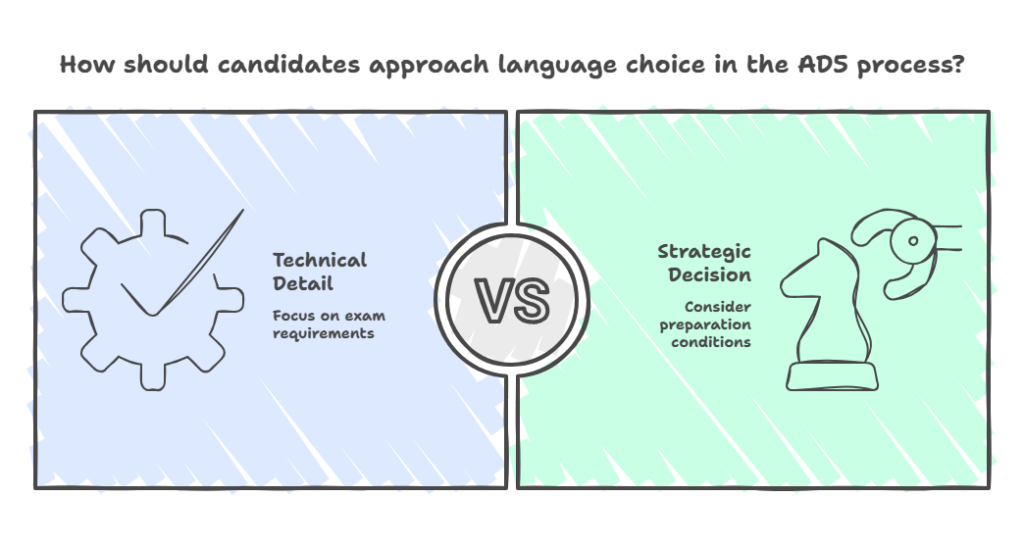
That is why language choice is not a technical detail.