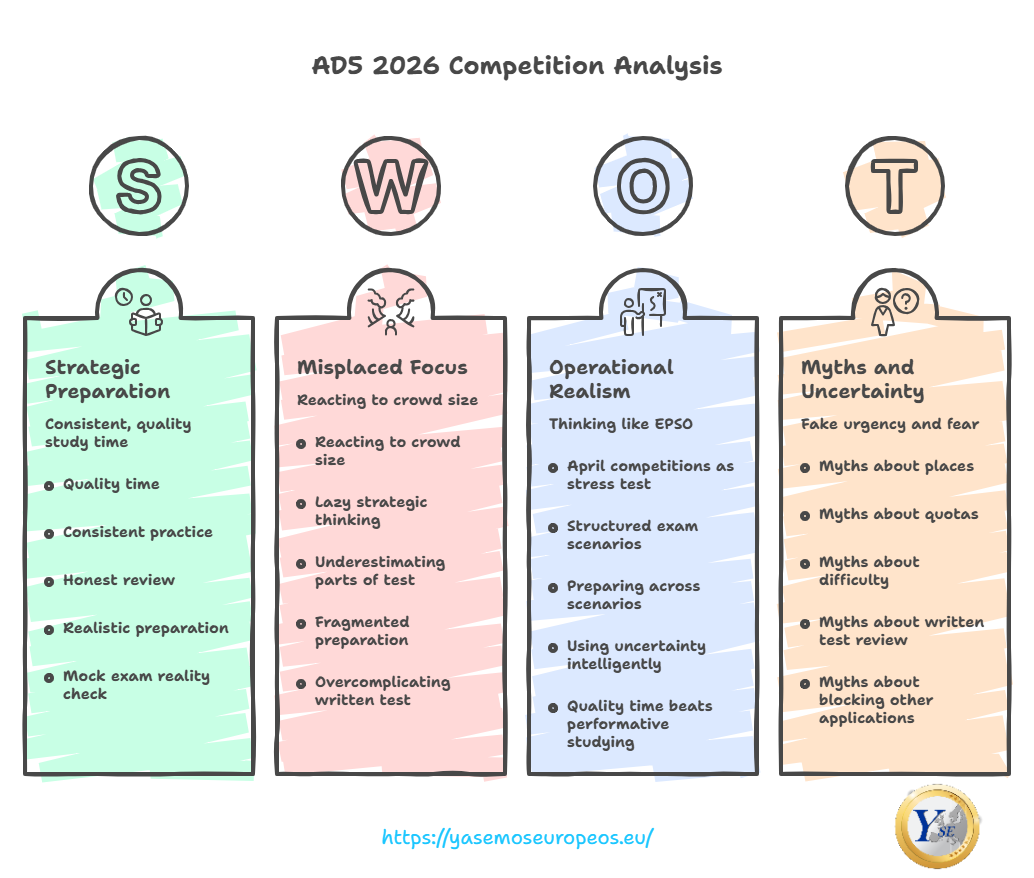
AD5 2026: Stop panicking about 174,922 candidates. Start understanding the game
AD5 Generalists/Graduates competition – Q/A presentation.
174,922 candidates. Endless speculation. People trying to predict exam dates with the confidence of a prophet and the evidence base of a random Telegram message. Rumours about quotas. Rumours about easier or harder versions by country. Rumours about EPSO increasing the number of places because “they have no choice now”.
Let’s say it clearly: most of that is nonsense.
And that was one of the main takeaways from our latest YSE webinar in English. Not just that there is a lot of noise — we knew that already — but that many candidates are reacting to the wrong thing. They are reacting to the size of the crowd, instead of understanding the logic of the competition.
That is how you lose focus. And in a competition like AD5, losing focus early is not a small problem. It is the problem.
The number is real. Your interpretation of it is probably not.
Yes, 174,922 candidates is a huge number. No point pretending otherwise.
Yes, EPSO almost certainly did not expect this volume.
Yes, this creates technical and logistical challenges.
But the first useful thing to understand is this: you are not really competing against 174,922 people in any meaningful sense.
We already have a relevant benchmark from recent competitions. In AD7 Building, roughly 30% of registered candidates did not even show up for the exam. If we apply that logic here — conservatively — we are already talking about more than 52,000 people effectively removing themselves from the competition before the real game even starts.
And that is before we even talk about those who will show up badly prepared, inconsistently prepared, or psychologically defeated by the number itself.
This matters because many candidates are using the raw registration figure as a mental excuse. “There are too many candidates, so the competition is basically impossible.” That conclusion is emotionally understandable. Strategically, it is lazy.
The number is big. Fine. But what matters is not how many people clicked “apply”. What matters is how many serious candidates will actually sit the exam and perform well enough across the full process.
That number is not the same.
AD5 is not an impossible competition. It is a ranking competition.
This is where many candidates — especially those coming from more traditional public exam cultures — get the logic wrong.
You are not trying to “pass” in a generic sense.
You are trying to rank high enough.
That sounds simple, but it changes everything.
If your mindset is “I just need to do okay”, you are probably not preparing at the right level. AD5 is not about scraping through. It is about placing yourself competitively in a large field, under pressure, with enough consistency to end up among those who move forward.
That is why all the magical thinking around cut-off scores is mostly useless at this stage. Nobody credible can give you an exact threshold now, because too many variables are still unknown: actual attendance, exam difficulty, how strong the serious candidate pool will be, whether the written is reviewed in the same stage or split, and so on.
What you can know already is much simpler: if you waste easy points, if you panic, if you underestimate one part of the test, if you prepare in fragments without training the whole exam dynamic, then the exact cut-off will not be your main problem. Your own performance will be.
That is uncomfortable, yes. It is also liberating. Because it puts the focus back where it belongs.
The process is not designed to admire you
One of the strongest points in the webinar was this: the process does not care how impressive you think your profile is.
That may sound brutal. It is also true.
You may be a lawyer, a doctor, a policy officer, an engineer, a pilot, a consultant, or someone with ten years of outstanding experience and a brilliant CV. Good. That may matter later. It does not change the basic filtering logic of this stage.
EPSO is trying to manage and assess an enormous number of candidates through a highly structured process. At this point, the competition is not designed to celebrate how unique you are. It is designed to filter at scale.
That is why so many candidates get frustrated. They enter the process thinking, “But I bring so much value.” Maybe you do. But that is not the same as saying the process is currently set up to reward that value in the way you expect.
Right now, the system is asking a much colder question: can you perform well enough, under these rules, to stay in the game?
Understanding that early helps. It stops you from wasting emotional energy on fairness fantasies and pushes you back toward what actually matters: execution.
Forget the myths. They are strategically useless.
A big part of the webinar was dedicated to myths, and honestly, that section remains necessary because the same bad ideas keep circulating.
No, EPSO is not going to increase the number of places just because a lot of people applied. That would require a change to the Notice of Competition, and there is no basis for assuming that will happen.
No, there will not be country quotas. The Notice does not allow that kind of discrimination.
No, candidates from more represented countries are not going to receive a tougher exam, and no, some language versions are not expected to be deliberately harder than others. Questions may differ across exam days if the test is split over multiple dates, but the level of difficulty must remain equivalent.
No, not every written test will be reviewed. Only the written tests of the top 2,235 candidates, based on verbal reasoning, EU knowledge and digital skills, will be assessed.
And no, being a candidate in AD5 does not block you from applying to other EPSO competitions, unless a specific notice explicitly says otherwise.
These myths are not harmless. They create fake urgency, fake fear and fake strategic dilemmas. They push candidates to spend time decoding rumours instead of building competence.
That is a bad trade.
If you want to understand what may happen next, think like EPSO
This is another angle that deserves more attention.
Candidates often try to read the competition from a purely personal perspective: “When will my exam be?” “Will my language combination be affected?” “Will they do X or Y?”
Those are normal questions. But they become more useful when you start asking a different one: what is operationally realistic for EPSO?
Right now, that means accepting two facts. First, the platform is still relatively new and still being tested under pressure. Second, the volume of candidates in AD5 is extraordinary.
That is why it makes sense to look at the April competitions — including AD7 Building and Data Management — as a kind of real-world technical stress test. If those exams run smoothly, EPSO may move faster. If they do not, everything gets more cautious.
This is also why the exam scenarios we discussed in the webinar matter, not as predictions carved in stone, but as structured ways of thinking. A very optimistic scenario would point to early July. A more reasonable scenario points to late summer or early autumn. A more conservative scenario pushes the exam toward the end of the year.
And yes, there is also a perfectly plausible possibility that the written test is not handled in the same way or at the same moment as the rest, given the technical complexity of managing such a large pool.
None of this is official. But some scenarios are clearly more grounded than others.
The wrong move is to obsess over certainty.
The right move is to prepare in a way that works across reasonable scenarios.
The biggest mistake now is waiting for perfect clarity
This is where many candidates quietly sabotage themselves.
They say they are “waiting for more information”. Waiting for the booklet. Waiting for the final exam format. Waiting for a date. Waiting for confirmation of whether the written will be on the same day. Waiting for a signal that it is finally time to take preparation seriously.
That is understandable. It is also dangerous.
Because the competition does not reward candidates who waited for ideal visibility. It rewards candidates who used uncertainty intelligently.
The logic is simple. Whenever the EU knowledge booklet is published, the clock becomes very real: two months. That is not the moment to start from scratch. That is the moment to consolidate, refine, intensify and adjust.
So yes, there is time.
But there is no time to waste.
That line came up in the webinar, and it is one of the best ways to frame the current moment. You do not need to panic. You do need to stop postponing.
What the tests are really measuring
Another reason candidates misprepare is that they misunderstand what the different parts of the competition are actually testing.
Verbal reasoning is not a language beauty contest. It is a test of information handling and interpretation under pressure. The trap is not weak grammar; the trap is using outside knowledge, overreading, or misreading the exact claim in front of you.
Numerical reasoning is rarely about advanced mathematics. It is usually about staying calm, identifying the right path, and not wasting time on a longer calculation when a shorter opportunity is available elsewhere. Choosing your battles matters.
Abstract reasoning is not about staring heroically at a pattern until revelation arrives. It is, above all, a time-management exercise. If you do not see the logic quickly, move on. Come back later. Do not donate your exam to one stubborn question.
Digital skills are also misunderstood. This is not advanced IT, and it is not a technical specialist test. EPSO has clearly pointed to DigComp 2.2 as the framework. That gives you a map, not a textbook. The job here is to organise what you already know, identify what you do not, and become comfortable with the concepts, vocabulary and basic practical logic that a normal professional digital environment requires.
And then there is the written test, which still scares many candidates for the wrong reasons. It is not a test of elegant prose. It is not asking you to be a literary genius in your language 2. It is asking you to communicate clearly, logically, concisely, and appropriately for a defined audience, using only the material provided.
Candidates often overcomplicate this task. That is one of the fastest ways to get into trouble. The written is already demanding enough because of time pressure and the need to process instructions on the spot. Adding unnecessary complexity is self-sabotage.
Short. Clear. Structured. Relevant. That is the game.
Quality time beats performative studying
This is one of the most useful parts of the webinar, and probably one of the least glamorous.
Many candidates want a dramatic preparation story. They want to believe success comes from punishing schedules, impossible marathons and heroic exhaustion. It sounds serious. It feels committed. It is often inefficient.
What tends to work better is something much less cinematic: quality time, repeated consistently.
A few solid hours per week now, building gradually, will beat chaotic overreactions almost every time. That is especially true in a competition that combines knowledge, technique, stamina and familiarity with formats. These are not things you cram well in panic mode.
You do not need to “kill yourself studying”.
You do need to become more solid every week.
That means reading intelligently, practising regularly, reviewing mistakes honestly, and gradually increasing the realism of your preparation. It also means allowing for recovery. If you are tired, rest. If you need a break, take one. But do not turn one day off into three weeks of strategic fiction.
Consistency is not sexy. It is still what moves people forward.
Your mock exam is not a formality. It is a reality check.
One part of the webinar we would absolutely keep in any serious preparation advice is the suggestion to run a full mock under realistic conditions before the real thing.
Not because mock exams are trendy. Because they are diagnostic.
A full mock reveals things that normal studying hides. It shows whether your timing collapses. Whether your concentration drops after the first block. Whether your written becomes messy under pressure. Whether your EU knowledge is broad enough to remain functional when mixed with fatigue. Whether your nerves distort your reasoning.
It also forces honesty. And honesty is a massive competitive advantage in EPSO.
Candidates who improve are usually those who can look at a weak performance and say, “Fine. This is the problem. I need to fix it.” Candidates who keep telling themselves they are “basically ready” without testing properly are often the ones who discover too late that they were rehearsing comfort, not competition.
In the end, only your work matters
That line from the webinar may sound blunt, but it is probably the cleanest conclusion.
Only your work matters.
Not the rumours.
Not the size of the crowd.
Not the fantasy that somehow this competition will become easier because it has become bigger.
Not the idea that your experience should somehow speak for itself.
Not the theory that luck will sort it out.
If you prepare well, strategically, and with enough consistency, you give yourself a real chance. If you do not, the competition will not compensate for that on your behalf.
AD5 2026 is big, noisy and still uncertain in some respects. Fine. But that does not make it unknowable. And it definitely does not make it unwinnable.
What it does is reward those who can filter signal from noise, stay calm, and do the work properly while everyone else is busy spiralling around the number 174,922.
That number is the headline.
It should not become your strategy.